
Sunday, June 24, 2018

Sorry!


I will not be able to post articles for two weeks due to camp. Thank you so much and if you have any feedback about this please say so in comments. Happy summer!!!!!!!!!!!

Thursday, June 14, 2018

NASA Encounters the Perfect Storm for Science


Animation of a fierce dust storm is kicking up on Mars
This set of images from NASA’s Mars Reconnaissance Orbiter shows a fierce dust storm is kicking up on Mars, with rovers on the surface indicated as icons.
Credits: NASA/JPL-Caltech/MSSS
One of the thickest dust storms ever observed on Mars has been spreading for the past week and a half. The storm has caused NASA's Opportunity rover to suspend science operations, but also offers a window for four other spacecraft to learn from the swirling dust.
NASA has three orbiters circling the Red Planet, each equipped with special cameras and other atmospheric instruments. Additionally, NASA's Curiosity rover has begun to see an increase in dust at its location in Gale Crater.
"This is the ideal storm for Mars science," said Jim Watzin, director of NASA's Mars Exploration Program at the agency’s headquarters in Washington. "We have a historic number of spacecraft operating at the Red Planet. Each offers a unique look at how dust storms form and behave -- knowledge that will be essential for future robotic and human missions."
Dusty With a Chance of Dust
Dust storms are a frequent feature on Mars, occurring in all seasons. Occasionally, they can balloon into regional storms in a matter of days, and sometimes even expand until they envelop the planet. These massive, planet-scaled storms are estimated to happen about once every three to four Mars years (six to eight Earth years); the last one was in 2007. They can last weeks, or even months at the longest.
The current storm above Opportunity, which is still growing, now blankets 14 million square miles (35 million square kilometers) of Martian surface -- about a quarter of the planet.

Two views from NASA’s Curiosity rover
These two views from NASA’s Curiosity rover, acquired specifically to measure the amount of dust inside Gale Crater, show that dust has increased over three days from a major Martian dust storm. The left-hand image shows a view of the east-northeast rim of Gale Crater on June 7, 2018 (Sol 2074); the right-hand image shows a view of the same feature on June 10, 2018 (Sol 2077). The images were taken by the rover’s Mastcam.
Credits: NASA/JPL-Caltech/MSSS
All dust events, regardless of size, help shape the Martian surface. Studying their physics is critical to understanding the ancient and modern Martian climate, said Rich Zurek, chief scientist for the Mars Program Office at NASA's Jet Propulsion Laboratory in Pasadena, California.
"Each observation of these large storms brings us closer to being able to model these events -- and maybe, someday, being able to forecast them," Zurek said. "That would be like forecasting El NiΓ±o events on Earth, or the severity of upcoming hurricane seasons."
The thin atmosphere makes these storms vastly different from anything encountered on Earth: Despite the drama of "The Martian," the most powerful surface winds encountered on Mars would not topple a spacecraft, although they can sand-blast dust particles into the atmosphere. 
Teamwork
Members of NASA's spacecraft "family" at Mars often help each other out. The agency's orbiters regularly relay data from NASA's rovers back to Earth. Orbiters and rovers also offer different perspectives on Martian terrain, allowing their science to complement one another.
The Mars Reconnaissance Orbiter has a special role, acting as an early warning system for weather events such as the recent storm. It was the orbiter's wide-angle camera, called the Mars Color Imager, that offered the Opportunity team a heads up about the storm. This imager, built and operated by Malin Space Science Systems in San Diego, can create daily global maps of the planet that track how storms evolve, not unlike weather satellites that track hurricanes here on Earth.

Simulated views of a darkening Martian sky
This series of images shows simulated views of a darkening Martian sky blotting out the Sun from NASA’s Opportunity rover’s point of view, with the right side simulating Opportunity’s current view in the global dust storm (June 2018).
Credits: NASA/JPL-Caltech/TAMU
NASA's two other orbiters -- 2001 Mars Odyssey and MAVEN (Mars Atmosphere and Volatile Evolution) -- also provide unique science views. Odyssey has an infrared camera called THEMIS (Thermal Emission Imaging System) that can measure the amount of dust below it; MAVEN is designed to study the behavior of the upper atmosphere and the loss of gas to space.
Science happens on the ground as well, of course. Despite being on the other side of the planet from the evolving dust storm, NASA's Curiosity rover is beginning to detect increased "tau," the measure of the veil of dusty haze that blots out sunlight during a storm. As of Tuesday, June 12, the tau inside Gale Crater was varying between 1.0 and 2.0 -- figures that are average for dust season, though these levels usually show up later in the season.
Fortunately, Curiosity has a nuclear-powered battery. That means it doesn't face the same risk as the solar-powered Opportunity.
The Next Big One?
Since 2007, Mars scientists have been patiently waiting for a planet-encircling dust event -- less precisely called a "global" dust storm, though the storms never truly cover the entire globe of Mars. In 1971, one of these storms came close, leaving just the peaks of Mars' Tharsis volcanoes poking out above the dust.

Graphic shows the ongoing contributions of NASA’s rovers
This graphic shows the ongoing contributions of NASA’s rovers and orbiters during a Martian dust storm that began on May 30, 2018.
Credits: NASA/JPL-Caltech
The most recent dust storm is the earliest ever observed in the northern hemisphere of Mars, said Bruce Cantor of Malin Space Science Systems, deputy principal investigator for the Mars Color Imager. But it could take several more days before anyone can tell whether the storm is encircling the planet.
If it does "go global," the storm will offer a brand new look at Martian weather. Four spacecraft stand ready to collect the science that shakes out.
Fine Print
JPL, a division of Caltech in Pasadena, California, manages the Mars Exploration Rover mission; the Mars Science Laboratory/Curiosity rover; the Mars Reconnaissance Orbiter Project; and the 2001 Mars Odyssey orbiter for NASA's Science Mission Directorate, Washington.

Graphic shows how the energy available to NASA’s Opportunity rover on Mars
This graphic shows how the energy available to NASA’s Opportunity rover on Mars (in watt-hours) depends on how clear or opaque the atmosphere is (measured in a value called tau). When the tau value (blue) is high, the rover’s power levels (yellow) drop.
Credits: NASA/JPL-Caltech/New Mexico Museum of Natural History
NASA's Goddard Space Flight Center in Greenbelt, Maryland, manages the MAVEN project for NASA's Science Mission Directorate, Washington. MAVEN's principal investigator is based at the University of Colorado Boulder's Laboratory for Atmospheric and Space Physics.
Lockheed Martin Space Systems, Denver, is the prime contractor for the Odyssey, MRO and MAVEN projects, having developed and built all three orbiters. Mission operations are conducted jointly from Lockheed Martin and from JPL for Odyssey and MRO, and jointly with the GSFC for MAVEN.
The Thermal Emission Imaging System (THEMIS) was developed by Arizona State University, Tempe, in collaboration with Raytheon Santa Barbara Remote Sensing. The THEMIS investigation is led by Philip Christensen at Arizona State University.
For more updates about the Martian dust storm visit:
For more information about NASA's Mars missions, visit:
Andrew Good
Jet Propulsion Laboratory, Pasadena, Calif.

Saturday, June 9, 2018

On Mars, NASA Finds ‘Organic’ Substances Linked to Life


The United States space agency says its Mars exploration vehicle has discovered chemical substances necessary for life.
Scientists reported that NASA’s Curiosity rover found large amounts of organic molecules in 3.5 billion-year-old rock in an area called Gale Crater. The area on Mars is believed to have once contained a large lake.
The discovery of organic molecules suggests that ancient conditions on Mars may have supported life.
Ashwin Vasavada is a scientist working on the Curiosity project at NASA’s Jet Propulsion Laboratory in Pasadena, California. He said the chances of being able to find signs of ancient life with future missions - if life was in fact present – “just went up.”
Jennifer Eigenbrode is an astrobiologist with NASA’s Goddard Space Flight Center in Maryland. She said there are three possible ways the organic material was created.
“The first one would be life, which we don’t know about. The second would be meteorites. And the last one is geological processes, meaning the rock-forming processes themselves,” she said.
NASA announced that Curiosity also discovered sharp seasonal increases in methane gas in the Martian atmosphere. This could also support the case for life. Ninety-five percent of the methane gas found in Earth’s atmosphere is produced by biological activity. Methane can come from animal and plant life, as well as the environment.
However, researchers said it is too early to know if the methane on Mars is related to life. This is because the gas - just like organic molecules – can also be formed by geological processes.
Eigenbrode believes the latest discoveries give scientists a good reason to keep looking.
“I think that we need to give the search for life on Mars due diligence,” she said. “We need to go to places that we think are the most likely places to find it.”
NASA’s latest findings were announced during a press conference last week and also released in the publication Science.
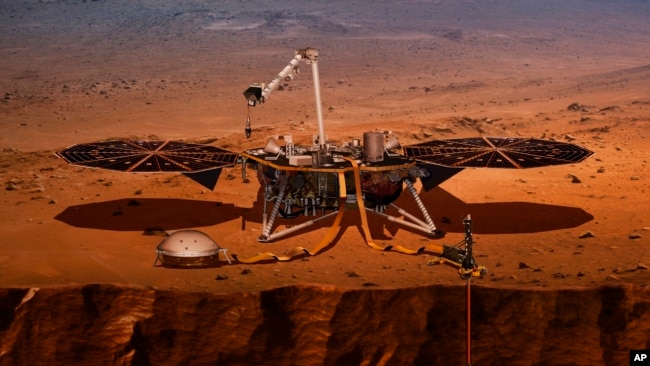
This 2018 illustration from NASA shows the InSight lander drilling into Mars. InSight, short for Interior Exploration using Seismic Investigations, Geodesy and Heat Transport, launched from Vandenberg Air Force Base on Saturday, May 5, 2011.
NASA head wants astronauts in orbit “in perpetuity”
Earlier this week, NASA Administrator James Bridenstine met with reporters to discuss the agency’s goals. He said there will likely be major changes related to the International Space Station (ISS) program.
President Donald Trump’s recent budget requests for 2019 have called for ending space station funding by 2025.
The U.S. government estimated it has spent more than $75 billion on building and supporting the International Space Station. After the space shuttle program ended in 2011, the U.S. has paid Russia to transport its astronauts to the space station.
This Thursday, April 26, 2018 photo provided by NASA shows James Bridenstine, the new administrator of the U.S. space agency, at NASA Headquarters in Washington. On Wednesday, June 6, 2018. (Bill Ingalls/NASA via AP)
The first piece of the International Space Station was launched in 1998 and was completely finished in 2011. It has been used to collect information and carry out many experiments.
Bridenstine said NASA is already in talks with private companies about possibly taking over the space station after 2025. But he added that any changes would have to be agreed to by the other 21 nations involved in the project.
But no matter what happens with the space station, the NASA chief said the U.S. remains committed to keep sending astronauts into space for many years to come.
“There are kids graduating from high school this month, that their entire lives, we’ve had an astronaut in space,” Bridenstine said. “And we want that to live on in perpetuity, forever.”

Bryan Lynn wrote this story for VOA Learning English, based on reports from AP and NASA. Mario Ritter was the editor.

Friday, June 8, 2018

Cool Craft: Nebula jar


Supplies needed: jar,cotton balls( depends how many you are make 1=1 bag of cotton balls), Tempera paintπŸ–ŒπŸ–Œ, fine glitter✨, fork/knife🍴🍴.
Steps:
1. Fill 1/3 of the jar with water and add tempera paint and shake.
2. Add glitter
3. Stretch out cotton balls and stick them in with the fork or knife until the layer is full.
4. Repeat the steps until the jar is full. 
- Mom dot.com

As Solar Wind Blows, Our Heliosphere balloons


What happens when the solar wind suddenly starts to blow significantly harder? According to two recent studies, the boundaries of our entire solar system balloon outward — and an analysis of particles rebounding off of its edges will reveal its new shape.
In late 2014, NASA spacecraft detected a substantial change in the solar wind. For the first time in nearly a decade, the solar wind pressure — a combined measure of its speed and density — had increased by approximately 50 percent and remained that way for several years thereafter. Two years later, the Interstellar Boundary Explorer, or IBEX, spacecraft detected the first sign of the aftermath. Solar wind particles from the 2014 pressure increase had reached the edge of the heliosphere, neutralized themselves, and shot all the way back to Earth. And they had a story to tell.
In two recent articles, scientists used IBEX data along with sophisticated numerical models to understand what these rebounding atoms can tell us about the evolving shape and structure of our heliosphere, the giant bubble carved out by the solar wind.
“The results show that the 2014 solar wind pressure increase has already propagated from the Sun to the outer heliosphere, morphing and expanding our heliosphere’s boundaries in their closest direction,” said David McComas, the principal investigator for the IBEX mission at Princeton University in Princeton, New Jersey. “IBEX data pouring in over the next few years will let us chart the expansion and evolving structure of the other portions of the heliosphere’s outer boundaries.”

From the Sun to the edge of the solar system — and back

At the crux of the story are energetic neutral atoms – high-energy particles produced at the very edge of our solar system.
As the solar wind flows out from the Sun at supersonic speeds, it blows up a bubble known as the heliosphere. The heliosphere encases all the planets in our solar system and much of the space beyond them, separating the domain of our Sun from that of interstellar space.
But the solar wind’s journey from the Sun is not a smooth ride. On its way to the very edge of our heliosphere, known as the heliopause, the solar wind passes through distinct layers. The first of these is known as the termination shock.
illustration depicting the layers of the heliosphere
An illustration depicting the layers of the heliosphere.
Credits: NASA/IBEX/Adler Planetarium
Before passing the termination shock, the solar wind expands rapidly, largely unimpeded by outside material.
“But at the termination shock, roughly 9.3 billion miles away from us in every direction, the solar wind slows down abruptly. Beyond this point it continues to move outwards, but it is much hotter,” said Eric Zirnstein, lead author of one of the papers at Princeton.
Once beyond the termination shock, solar wind particles enter a special limbo zone known as the heliosheath. While the termination shock is essentially spherical, the edges of the heliosphere are thought to describe more of an arc around the Sun as it moves through space — closer to the Sun toward the front, and extending long behind it, not unlike a comet with a tail. Along these boundaries, solar wind particles mix with particles from interstellar space. Collisions are inevitable: the hot, electrically-charged solar wind particles bang into the slower, colder neutral atoms from interstellar space, stealing an electron and becoming neutral themselves.
“From there they go travelling ballistically through space, and some make it all the way back to Earth,” Zirnstein said. “These are the energetic neutral atoms that IBEX observes.”
This video explains how a solar wind particle becomes an energetic neutral atom detected by IBEX.
Credits: NASA’s Goddard Space Flight Center
In late 2016, when IBEX’s energetic neutral atom imager began to pick up an unusually strong signal, Professor McComas and his team set out to investigate its cause. Their findings are reported in an article published on March 20, 2018, in the Astrophysical Journal Letters.
The energetic neutral atoms were coming from about 30 degrees south of the interstellar upwind direction, where the heliosheath was known to be closest to Earth.
To quantify its connection to the 2014 solar wind pressure increase, McComas and his team turned to numerical simulations, working out how such a pressure increase could affect the energetic neutral atoms that IBEX observes.
 “These types of simulations involve a model for the physics, which then gets turned into equations, which are in turn solved on a supercomputer,” said Jacob Heerikhuisen, a coauthor on both papers at the University of Alabama in Huntsville.
Using computer models, the team simulated an entire heliosphere, jolted it with a solar wind pressure increase, and let it run the numbers. The simulation completed a story only hinted at by the data.
According to the simulation, once the solar wind hits the termination shock it creates a pressure wave. That pressure wave continues on to the edge of the heliosphere and partially rebounds backwards, forcing particles to collide within the (now much denser) heliosheath environment that it just passed through. That’s where the energetic neutral atoms that IBEX observed were born.
The simulations provided a compelling case: IBEX was indeed observing the results of the 2014 solar wind pressure increase, more than two years later.
But the simulation didn’t stop there. It also revealed that the 2014 solar wind pressure increase would, over time, continue to blow up the heliosphere even further. Three years after the solar wind pressure increase — by the time the article was published — the termination shock, the inner bubble within the heliosphere, should expand by seven astronomical units, or seven times the distance from Earth to the Sun. The heliopause, the outer bubble, should expand by two astronomical units, with an additional two the following year.
In short, by cranking up the pressure of the solar wind, our heliosphere today is bigger than it was just a few years ago.

The heliosphere’s new shape

McComas and colleagues studied the very first signs of the 2014 solar wind pressure increase. But watching the data over the coming years may tell us even more — this time about the evolving shape of our heliosphere.
“There have been many studies, some from quite a while ago, predicting what the heliosphere shape should look like,” Zirnstein, the lead author of the paper, reports. “But it’s still very much up for debate in the modelling community. We’re hoping that the 2014 solar wind pressure increase could help with that.”
Using the same data and simulations used in the previous paper, Zirnstein and colleagues ran the clock forward, modeling the heliosphere eight years after the 2014 solar wind pressure increase. The results describe not only the past, but also model the future. The paper was published on May 30, 2018, in The Astrophysical Journal.
“What we think we should see in the near future is a ring, expanding across the sky, marking the change in energetic neutral atom flux over time,” said Zirnstein. “This ring expands away from the point of initial contact in the outer heliosphere, towards the directions of the heliotail.”
triptych of ENA flux change
After an initial spike, energetic neutral atoms should rain back down on IBEX, forming a ring that expands across the sky over time.
Credits: Eric Zirnstein
Although the initial signal detected by IBEX in 2016 was a solid circle, it won’t stay that way. As the 2014 solar wind reaches points of the heliopause further and further away, they take longer to bounce back, like an echo off of a far-away wall. The heliosphere’s rounded shape causes this echo to reflect back in the form of a ring.
But the key finding came from watching the ring as it expands.
In their simulation, Zirnstein and colleagues found that the precise rate at which the ring expands depended in part on the distances between the various layers of the heliosphere: the termination shock, the heliopause, and the part of the heliosheath where the energetic neutrals were produced.  Zirnstein realized he had found a new way to measure the size and shape of the heliosphere.
“We could estimate the distances to the different boundaries of the heliosphere just by looking at this ring changing over time in the sky,” said Zirnstein.
Zirnstein and colleagues used their simulated heliosphere to run a test study. By measuring the rate of expansion of the ring (and plugging it into the right equations), they could accurately reproduce the distances to key structures within their simulated heliosphere.  Since they knew what those distances were in their simulation, they could check their work — validating that the technique got the right answers and should be accurate when applied to the real heliosphere.
Deformities in the ring — deviations from a perfect circle — could also reveal asymmetries in the heliosphere’s overall shape. “It depends on how symmetric or asymmetric the heliosphere is,” Zirnstein added. “If the heliosphere was an ideal ‘comet shape,’ the ring should expand symmetrically over time. But in reality that’s probably not going to happen — we’ll have to wait and see what IBEX tell us.”
Zirnstein expressed excitement about the possibility of learning the true shape of the heliosphere.
“Over the next few years with more IBEX data, my hope is that we can build a 3D picture of the shape of the heliosphere,” said Zirnstein.
The results of these two studies have important practical implications. “Connecting changes in the Sun with energetic neutral atom observations will help us understand long term changes in the hazardous conditions for space radiation environment — a sort of space climate as opposed to space weather,” McComas said. “As the solar wind blows more and less hard, and our solar bubble expands and contracts, which directly affects the amount of cosmic rays that can enter the heliosphere, potentially endangering astronauts on long duration spaceflights.”
But the results also underscore the incredible power of our closest star. Changes on the Sun, including the solar wind, have significant consequences extending billions of miles into space where, to date, only the two Voyager spacecraft have ever ventured. With techniques like energetic neutral atom imaging, we cannot just picture, but precisely measure these far-off portions of the heliosphere — our home in the galaxy.
Related:

Thursday, June 7, 2018

Mars rover discovery.


NASA’s Curiosity rover has found new evidence preserved in rocks on Mars that suggests the planet could have supported ancient life, as well as new evidence in the Martian atmosphere that relates to the search for current life on the Red Planet. While not necessarily evidence of life itself, these findings are a good sign for future missions exploring the planet’s surface and subsurface.
The new findings – “tough” organic molecules in three-billion-year-old sedimentary rocks near the surface, as well as seasonal variations in the levels of methane in the atmosphere – appear in the June 8 edition of the journal Science.
Organic molecules contain carbon and hydrogen, and also may include oxygen, nitrogen and other elements. While commonly associated with life, organic molecules also can be created by non-biological processes and are not necessarily indicators of life. 
“With these new findings, Mars is telling us to stay the course and keep searching for evidence of life,” said Thomas Zurbuchen, associate administrator for the Science Mission Directorate at NASA Headquarters, in Washington. “I’m confident that our ongoing and planned missions will unlock even more breathtaking discoveries on the Red Planet.”
“Curiosity has not determined the source of the organic molecules,” said Jen Eigenbrode of NASA’s Goddard Space Flight Center in Greenbelt, Maryland, who is lead author of one of the two new Science papers. “Whether it holds a record of ancient life, was food for life, or has existed in the absence of life, organic matter in Martian materials holds chemical clues to planetary conditions and processes.”
Although the surface of Mars is inhospitable today, there is clear evidence that in the distant past, the Martian climate allowed liquid water – an essential ingredient for life as we know it – to pool at the surface. Data from Curiosity reveal that billions of years ago, a water lake inside Gale Crater held all the ingredients necessary for life, including chemical building blocks and energy sources. 
“The Martian surface is exposed to radiation from space. Both radiation and harsh chemicals break down organic matter,” said Eigenbrode. “Finding ancient organic molecules in the top five centimeters of rock that was deposited when Mars may have been habitable, bodes well for us to learn the story of organic molecules on Mars with future missions that will drill deeper.”
Seasonal Methane Releases
In the second paper, scientists describe the discovery of seasonal variations in methane in the Martian atmosphere over the course of nearly three Mars years, which is almost six Earth years. This variation was detected by Curiosity’s Sample Analysis at Mars (SAM) instrument suite. 
Water-rock chemistry might have generated the methane, but scientists cannot rule out the possibility of biological origins. Methane previously had been detected in Mars' atmosphere in large, unpredictable plumes. This new result shows that low levels of methane within Gale Crater repeatedly peak in warm, summer months and drop in the winter every year.
"This is the first time we've seen something repeatable in the methane story, so it offers us a handle in understanding it," said Chris Webster of NASA’s Jet Propulsion Laboratory (JPL) in Pasadena, California, lead author of the second paper. "This is all possible because of Curiosity's longevity. The long duration has allowed us to see the patterns in this seasonal 'breathing.'" 
Finding Organic Molecules
To identify organic material in the Martian soil, Curiosity drilled into sedimentary rocks known as mudstone from four areas in Gale Crater. This mudstone gradually formed billions of years ago from silt that accumulated at the bottom of the ancient lake. The rock samples were analyzed by SAM, which uses an oven to heat the samples (in excess of 900 degrees Fahrenheit, or 500 degrees Celsius) to release organic molecules from the powdered rock.
SAM measured small organic molecules that came off the mudstone sample – fragments of larger organic molecules that don’t vaporize easily. Some of these fragments contain sulfur, which could have helped preserve them in the same way sulfur is used to make car tires more durable, according to Eigenbrode.
The results also indicate organic carbon concentrations on the order of 10 parts per million or more. This is close to the amount observed in Martian meteorites and about 100 times greater than prior detections of organic carbon on Mars’ surface. Some of the molecules identified include thiophenes, benzene, toluene, and small carbon chains, such as propane or butene.
In 2013, SAM detected some organic molecules containing chlorine in rocks at the deepest point in the crater. This new discovery builds on the inventory of molecules detected in the ancient lake sediments on Mars and helps explains why they were preserved.
Finding methane in the atmosphere and ancient carbon preserved on the surface gives scientists confidence that NASA's Mars 2020 rover and ESA’s (European Space Agency's) ExoMars rover will find even more organics, both on the surface and in the shallow subsurface. 
These results also inform scientists’ decisions as they work to find answers to questions concerning the possibility of life on Mars. 
“Are there signs of life on Mars?” said Michael Meyer, lead scientist for NASA's Mars Exploration Program, at NASA Headquarters. “We don’t know, but these results tell us we are on the right track.”
This work was funded by NASA's Mars Exploration Program for the agency’s Science Mission Directorate (SMD) in Washington. Goddard provided the SAM instrument. JPL built the rover and manages the project for SMD.

-Dwayne Brown / JoAnna Wendel
Headquarters, Washington
202-358-1726 / 202-358-1003
dwayne.c.brown@nasa.gov / joanna.r.wendel@nasa.gov
Bill Steigerwald / Nancy Jones
NASA Goddard Space Flight Center, Greenbelt, Maryland
301-286-8955 / 301-286-0039
william.a.steigerwald@nasa.gov / nancy.n.jones@nasa.gov
Andrew Good
Jet Propulsion Laboratory, Pasadena, Calif.
818-393-2433
andrew.c.good@jpl.nasa.gov
Last Updated: June 7, 2018
Editor: Sean PotterπŸš€πŸš€πŸš€πŸš€πŸš€πŸš€πŸš€πŸš€πŸš€πŸš€πŸš€

Crazy!!!!

Did you know? Most newspapers have a section on astrology (a study on zodiac signs which are nonscientific) and no section on astronomy!...